Friday, March 07, 2014

Moscow (Part IV - Two Days Before)


Click here for Parts I, II, III

My flight was leaving early Wednesday morning.

On Monday night, after work, I went to the supermarket to buy non-perishable kosher food for my trip. Laden down with groceries, I stopped to sit on a bench on the way home, and got the following text from my new roommate: "Wylie still not home. Thought you should know." He'd been out of the house now for 24 hours, probably cavorting with his friends in the bushes around the corner, but still, I should look for him.

So I dropped off the groceries and went to look for my cat. I called his name up and down all over the neighborhood. Finally I heard a faint "meow" answering me. I called, he answered. I followed the voice. I called, he answered . . . why wasn't he coming to me?

Using the light of my phone, I found him in an unused boiler room under a nearby building. He was meowing, but not getting up. I was terrified. I scooped him up and took him home, where I discovered that one of his hind legs had a wound so gaping, I could see significant amounts of muscle. He was trailing drops of blood behind him.

Very upset, I arranged for an emergency trip to the veterinarian at
10 o'clock at night.  The vet announced Wylie to be infected and dehydrated, and gave him antibiotics, and painkiller, and IV fluids, and said I'd have to bring him back in the morning so that the clinic could stitch and clean him up properly.

I was petrified about what would happen to my cat, and also – the stress of the time this was taking, and the money, and the anxiety was not well-timed, given that I was leaving for
Moscow in about 24 hours.

Moscow (Part III - Matrushka Dolls)


Click here for Part I, II

I love matrushka dolls, both as a toy and as an art form. I love seeing how the painters reduce the complexity of the designs as the dolls get smaller and smaller. I love that they come in so many different styles. And I love the ones that have eeny-weeny baby dolls in the middle.  They are just so cute, and I think they are under-rated as a form of art.

I owned just one, a souvenir that a friend brought me from
Poland. Reviews of Moscow's Matrushka Doll Museum said it's only two rooms and displays dolls from only one specific time period, but that it has an excellent gift shop. I set aside a fairly significant sum of money to buy souvenirs there for myself, and gifts for friends. After the Kremlin, Red Square, and the Bolshoi, the Matrushka Doll Museum was the only site I was determined to see while visiting Moscow.

I was so excited! Moscow! Kremlin! Jews! Matrushka dolls!


Thursday, March 06, 2014

Moscow (Part II - Planning)

Click here for Part I of this series.


HOW I PREPARED (BUT CLEARLY NOT ENOUGH)

Before traveling to Moscow, I had been outside America and Israel to only two places: London (where I speak the local language), and Vienna (which I visited with my mother, a native German-speaker). This would be my first time traveling alone to a country that was new and strange to me, and where I do not speak the language. It would be an adventure!

I had only a few weeks to prepare. Preparing, anticipating – it's half the fun of going away on a trip! I worked hard to be ready for any potential problems, and to enjoy the process.
  • Borrowed a friend's "Russian the Fun Way" textbook and learned to read the Cyrillic alphabet, so at least I could sound out words on signs.
  • Bought a Russian phrase book and familiarized myself with how it's organized.
  • Carefully researched where to spend Shabbat, since that would affect the short list of hotels I'd look into (within walking distance of my Shabbat plans). Got connected with the "Israelis in Moscow" group, affiliated with the Chabad center at Moscow's Marina Roshcha synagogue - perfect!
  • Carefully researched hotel room prices and booked a room for six nights at the Metallurg; online reviews warned that the reception desk clerks do not speak English, but I figured between my phrase book and miming maybe I'd be OK. Anyhow, everyone told me that in central Moscow, it is easy to find people who speak English – the language shouldn't be a problem.
  • Researched the kosher food situation: there is a kosher mini-market near my hotel, and a few kosher restaurants, but it would be smart and cheaper to bring my own food
  • Connected with my colleagues in Moscow, Rusina and Michael. Rusina made an itinerary for me for two days of my trip, for me to see Jewish Agency programs in person (for example, schoolchildren learning Judaism in Moscow – a miracle!) and to meet other colleagues and emerging leaders in the Jewish community there.
  • Read "Moscow Top 10" cover to cover and made a short list of tourist attractions I want to see. At the top of my list were, of course, Kremlin and Red Square (conveniently located near The Jewish Agency offices), and third was the little-known Matrushka Doll Museum
  • Booked a ticket to the Bolshoi Ballet. Most of the nights I'd be in Moscow, the Bolshoi was doing opera, not ballet. So I bought a ticket for the one night they were doing ballet that wasn't also Shabbat. I knew it would be modern ballet, not classical, so I knew not to expect fancy tutus. People asked me what I'll be seeing, and I said "I don't know. I had one night to choose from, so whatever it is they are performing that night, that's what I'll see." For the equivalent of 250 NIS I got a seat in the 10th row, center aisle. I was so excited and felt very fancy, having such a wonderful seat booked at the Bolshoi Ballet.
  • Went to buy rubles. The currency exchange place I visited in Jerusalem said they don't sell rubles, but I could buy dollars and then exchange those when I got to Russia. I decided to avoid doubling my fees, and figured I'd try again at Ben Gurion airport; if the money changer there didn't sell rubles, either, I could always buy dollars at that point.
  • Ordered a new credit card. The Isracard I've used for the past 10 years is not international; it's usable only in Israel. I've managed for 10 years without a Visa or Mastercard, but when going to a foreign country I figured an international credit card would be a smart idea. Don't want to get stuck without funds!
  • Arranged with my new roommate to take care of my cat, Wylie. When I left for Moscow, Yasminah had been living in the apartment only a few days, but she's smart and sweet and it's not hard to give Wylie fresh food and water every day. My friends Mory and Yardena said that Mory would come over a few times to clean the litter box.
  • Kept a running list of what to pack.
  • Compiled Wikipedia entries on various aspects of Russian history into one Word document and printed it out: 80 pages of background reading for the flight on the way to Moscow!
  • Did some research into how I could get phone service while in Russia, and decided simply to buy a sim card at the airport there.
  • Bought traveler's health insurance in case I got hurt in some way.
  • Made a list of emergency phone numbers
  • Sent an email to people at work, friends in Israel, and my family in America letting them know what I could about my itinerary and how to reach my hotel and each other.


I'm a great planner, right?

I Went to Moscow So Now You Don't Have To (Part I - Why I Went)

I was urged to write this blog series by friends on Facebook who were wondering why I was so, so very glad to be back home from my vacation in Russia. This will take many posts to explain properly. Buckle your seat belt and have fun; I didn't.

WHY I WENT TO MOSCOW

Optimism is a powerful force. When I went to journalism school, it was with the specific goal of becoming a freelance magazine journalist. During my time there, many faculty members said "freelancing is really tough. You'll never make it if you don't take an entry-level position, work your way up in the field, develop your network, and THEN become a freelancer."

My internal response was always "there's something they know that I don't know, which is how difficult it is to freelance. But there is something I know that they don't know, which is how badly I want it, and how determined I am." I was pretty successful at freelancing for many years, until I wasn't.

I never set a goal of going to Moscow, but when the chance came unexpectedly, I jumped at it. I work for The Jewish Agency for Israel, as a marketing writer, and therefore often write materials (mostly donor-relations materials) for our Unit for Russian-Speaking Jewry. I recently wrote a material urging Jewish groups to go on  organized visits to our activities in Moscow, and so I knew something both about the tourist attractions there and the activities of the Jewish community. It never occurred to me to go myself; if I were going to spend money on an "exotic" vacation, there are other destinations I'd rather see first.

But El Al, the national airline of Israel, had a "Fun Day" about 2 months ago, during which, for 24 hours, the prices to select (not-popular-in-winter) destinations were rock bottom. For $200 I could go round-trip to Moscow, St. Petersburg, or Valencia.

Valencia would be more relaxing, but I have no connections there and have never been specifically interested in seeing Spain. But in Russia I could see these programs I write about all the time; I have colleagues at our Jewish Agency offices in Moscow (and St. Petersburg) who could help me if something went really wrong (an important point, since I speak neither Russian nor Spanish; in Russia I wouldn't feel as alone); and most importantly, I was sincerely and deeply curious to see Jewish life in the former Soviet Union.


Having grown up in the USA in the 1980's, the idea of being able to witness, with my own eyes, children studying in Jewish day schools in Moscow was very, very compelling, even if it is the middle of a Russian winter; in the summer I could never afford it.

Everyone said I'm crazy. The weather is terrible, and anyway who goes to Moscow on VACATION? There was something they knew that I didn't, which is how ugly and cold and not-vacation-like Moscow is. But there was something I knew that they didn't, which is how deeply connected I feel, for some reason, to my Russian-speaking colleagues and to Russian-Israelis, how cool I, personally, felt it would be to interact with the Jewish community of Moscow, and to see the Kremlin and Red Square. For $200, it was within reach now.

So I booked the ticket.

Thursday, January 30, 2014

Sketch Artist

Last spring, a video advertisement for Dove went viral:


It shows a series of women describing themselves to a sketch artist, who draws their portraits based on their self-descriptions. Then, each woman is described to the artist by someone else -- and the resulting sketch is always more attractive. In every case, the way a stranger described the subject was more attractive than the way the subject described herself.

I thought of this video when I went to see a temporary exhibit at the Israel Museum called "Making an Entrance: Jewish Artists in 19th-Century Europe." The exhibit looks at how Jews in the 1800's, who were just being allowed into art academies or otherwise gaining formal training in painting, dealt with their Jewishness in their work. Some hid it, so they could blend more successfully into Europe's higher society. Some (well, one, anyway, in this exhibit) painted scenes of Jewish families celebrating Jewish holidays. And another initially painted neutral subjects, and later in life started painting nostalgic portraits of other (identifiably-Jewish) Jews.

Even though the quality of the works is mixed (I'm no expert, and obviously I personally could never dream of painting ANY of those works so beautifully, but still - I do have a feel for what paintings made it into the exhibit because they are extraordinary displays of talent, and which are in the exhibit because they are done by Jews, and pretty darn good), I loved this exhibit because the people in the portraits looked like people I know.

To get to the exhibit, one must walk through the Israel Museum's permanent, and rather random, display of Dutch art, which touches me not at all - I enjoy neither the style of painting, nor the subject matter, though I respect them both. But one room away are paintings of Jews, and even if they are wearing European clothes and hairstyles of the time, they still look exactly, and touchingly, like the people I see in synagogue all the time. You can even tell which little kid is most likely to charm her way into an extra lollipop from the candy man, and which woman would, if she were alive today, agitate for feminist reforms in her Orthodox synagogue. These are MY people.

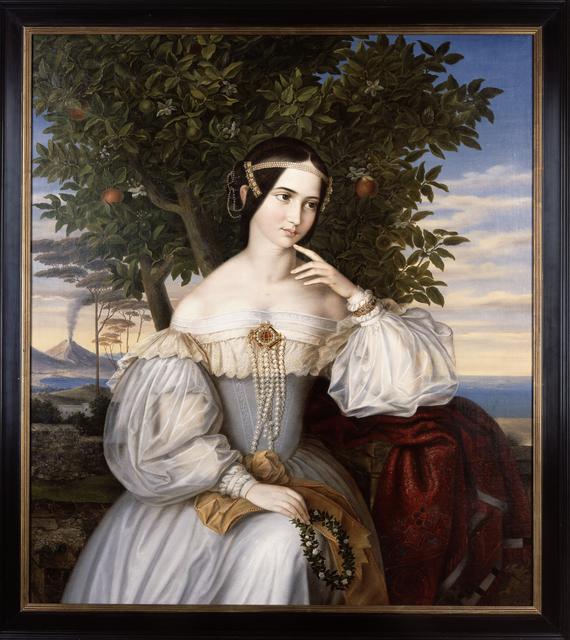
Anyway, in 1836, Moritz Daniel Oppenheim painted wedding portraits of then-17-year-old Charlotte von Rothschild and her new husband, her first cousin, Lionel de Rothschild. This is the portrait he painted of Charlotte:


The painting shows a young, sweet-looking, attractive, vital young woman wearing the latest styles in finery. I'm sure that Oppenheim was paid in part to make her look as beautiful as possible, minimizing any flaws, but still - she must have looked SOMETHING like this.

Young Charlotte was immensely interested in art and became an accomplished painter in her own right. Just two years after her marriage, she produced the following self-portrait, a sketch she made to prepare for her "Self-Portrait with My Family":


Here we have a relatively frumpy woman, who could be in her 30's, with unruly curls, bags under her eyes -- which are looking in different directions --  and comparatively dowdy clothing. Remember, she produced this just two years after Oppenheim painted the work above.

And that's why I thought about the Dove commercial, there in temporary exhibit space at the Israel Museum.

Sunday, April 15, 2012

Serenity and Courage

Years ago I bought an interesting book by Rabbi Marc D. Angel, entitled But Who Am I, and Who are My People?: A Rabbi's Reflections on the Rabbinate and the Jewish Community. A story in the introduction has stuck with me all these years. The book is in storage, or perhaps was loaned out long ago, so I don't have it in front of me, but the story goes something like this:

In a little Jewish village there was a man who was mentally simple and therefore could not keep a job for very long. Without money for food, and with his job prospects dried up, he went to the rabbi to beg for funds. The rabbi wanted to help the man keep his dignity, so rather than give him a handout, he created a "job" for this man. He instructed the man to sit every day by the entrance to the village and wait for the Messiah. As soon as he saw the Messiah approaching, the man was to call the alarm to the village to let them know that the great day had arrived and they should prepare. The rabbi reasoned that even a simple person could do this job, and that it would allow the man to be "employed" for many years.

The man was thrilled to have a job and was confident that he could do it. He accepted his first week's pay, and left enthusiastically to start his new job.

A few days later, the man returned to the rabbi's house and quit his position. It was, he said, too stressful. The job required him to be patient all the time, sitting by the village entrance and waiting; but also to be impatient all the time, being alert to the possibility that the Messiah might arrive any minute.

Rabbi Angel compared this "job" the one he'd held for many years: that of congregational rabbi. To be a pulpit rabbi, he wrote, requires one to be infinitely patient: to embrace the congregants at whatever state of spirituality or ritual observance they were at the moment; to encourage them slowly, slowly to broaden their Jewish views and behaviors; to love and lead them even when they refused to listen; to accept setbacks with equanimity. And at the same time, to be a pulpit rabbi requires infinite impatience: to dream of greater Jewish engagement for the community; to devote boundless energy to growing the congregation; to envision the limitless heights in chessed and scholarship that the congregants might be able to attain.

And indeed, he wrote, it is all often quite stressful.

It occurred to me today that being single (when one prefers to be partnered) requires the same balance.

To be infinitely impatient. To keep your heart open to the possibility of meeting (or recognizing in someone you already know) someone whom you could allow to love you; to join every possible dating site and accept every reasonable-sounding blind date idea; to remember always your own value and how much you deserve to have exactly what you want; to pray, as we in the Orthodox community are instructed to do, for God to fulfill your desires; to go on every date with an open mind; to never succumb to bitterness or allow your ego to be crushed by rejection or disappointment; to stay cheerful and confident, first for yourself and second because cheerful confidence is more attractive; to get a little angry when you can't find what you want, because you know you are a great catch and you know the right person must be out there; to maintain faith that soon, soon, things will change. To have the courage to change them by dressing nicely every day, going to singles events, remaining hopeful -- because to be impatient, to take action, takes courage.

To be infinitely patient. To understand that dating is an area of life in which ultimately you have no control at all. To embrace the possibility that perhaps, in fact, you are destined to be single for the rest of your life -- and to be OK with that. To have the confidence to know that you, yourself, are enough, whether you have a partner or not. To never need a relationship to feel validated or whole. To build a rich, active life for yourself, full of activities that you enjoy, whether they include eligible men or not. To read, to travel, to go back to school, to have a baby on your own, to buy your own house or write your book or start your own business, because you are determined to be happy and fulfilled even if you never get everything you want. To be serene enough to accept the things you cannot change -- because to be patient, to wait, takes serenity.

It is stressful. We sit at the gates of our lives, telling ourselves to stay alert, be impatient, because the thing we want could come any minute but -- go on with our lives, embrace Plan B, just in case.

Saturday, March 31, 2012

Signs

On Thursday evening I walked home from work at about 8 pm, feeling wistful and sad about various events (having nothing to do with work, by the way). By the time I had gotten to Emek Refaim Street, I had tears in my eyes. It happens. I wear my emotions close under the skin. That's just how I am.

I've been having trouble lately with my relationship with God. By "lately" I mean "for the last several years." Frankly, I've been pretty much ignoring him. Well, that's not entirely true. I still say brachot (blessings) on my food, make an effort to do things like keep kosher and sit in a sukkah, that sort of thing. And every morning at the bus stop I pray silently for the bus to come soon, and if it comes immediately I give God an internal high five. The high five reflects a vestigial feeling, left over from when it still really mattered to me that God controls everything in the universe -- even how long I have to wait at a bus stop --  and that everything happens for a good reason. It's not that I don't believe this any more – I don't know whether I do or not --  but that I got tired of thinking about it. Like I said, ignoring.

I consider myself pretty rational for an Orthodox Jew. For example, I've never put much stock into "Segulahs," and in fact consider most of them to be dangerously close to Avoda Zarah (idol worship). When I hear stories about the people who, say, were childless for 10 years and then got a bracha (blessing) from a famous rabbi and had a baby 10 months later, my usual response is to wonder about the many women who got the bracha but did not have a baby, or the women who have babies after 10 years without getting a bracha.  Still, I used to be far, far more spiritual than I've been lately. I used to talk to God all the time. Now, my feeling is, he leaves me alone (not fair, I know), so I will leave him alone.

Anyway, shortly after passing the video store on Emek, but before the Community Center, I saw a piece of white A4 printer paper on the sidewalk, being stepped on by other pedestrians as they walked over it. Upon some inspection it looked like a school paper of some kind, with a lot of writing on it, and my curiosity got the better of me, so I picked it up to see what it was. There was no name on it. On the back were a few meaningless scribbles, but on the side that had been facing up, this was typed:

--3--

King Solomon looks at the woman with great pity and says:

"Arise my daughter! Come, sit by my side and rest awhile. I shall have bread and wine brought before you. Then, after you are refreshed, I shall bring forth your judgment to light."

And so the woman sits by his side and there is bread and wine brought in for her. While she is refreshing herself, two strangers from far away lands come to the palace.

The horn is blown again ---

The strangers walk into the hall. They bow down low before King Solomon, and the king says to them:

"Arise, strangers, and tell us who you are and what is your story."

"Oh, Great King of Israel! Merchants are we, from the lands of the sea. One day – we hired a boat to ship our merchandise to a far away land. (Come my friend!) We climbed into the boat and we started our trip. At first the sea – is calm – the trip is good. Then, suddenly, the sea boiled us – the waves became bigger and bigger – and the boat was tossed back and forth with no course. And then – a hole burst open at the bottom of the boat! The water flowed in – the boat is sinking, sinking – In a little while we are lost. We turn to our Gods and call out:

God of Sidon! God of Ammon! God of Moab! God of Eddom! Gods of Canaan!

But to no avail. There is no answer. And the waters keep filling the boat. We are standing neck deep in water. The fear of death is upon us. And at that moment we remember your God, King Solomon, the God of Israel, and we cried out to him as well:

God of Israel, save us this day, and we shall give all our goods – gold, silver and precious stones to your temple in Jerusalem!

Hardly have we uttered the words when a mighty gust of wind – falls upon us – and within the wind – a small bundle swirls around – and the wind hurles the bundle into the boat – the bundle falls into the hole – the hole is plugged up!

We are saved! We are saved!

The storm calms down. The wind disappears. The sea – is smooth again. We row back to land – and when we reach the shore, we climb out of the boat with our heavy sack of merchandise. (Here, my friend, take this heavy sack.) And thus we made our way to Jerusalem. And here we are, great King of Israel, and this is our sack of gold. May this offering please your God, as we do not know how to worship Him."

I have to admit I was moved – enough to take the trampled, dirty piece of paper home. I don't know if I believe in signs, but the fact is that other people walked right by this paper that had been typed up by some anonymous writer or student somewhere, and I was the one who went to the trouble of picking it up and reading it, on a night when I was experiencing turbulent emotional seas. And I feel that perhaps God is waiting for something from me. I don't know what it is, but maybe it's time for me to figure out, in a way that is appropriate for who I am now and at this stage of my life, how to worship Him.

Friday, March 02, 2012

How To Preserve Your Food Memories for Generations Without Making Your Grandchildren Frustrated


Lately I've been editing recipes, and using new recipes that I find on the internet, and in both cases I encounter confusing, unclear instructions. Recipe-writing is actually a craft unto itself; courses in "food writing" include units on how to write cooking instructions. So this post is for those of you out there who write recipes for your family, your website, or your work, from the point of view of a copyeditor.

Err on the side of too much detail, rather than too little. Assume your reader knows very little about cooking. Unless your recipe is going to be published in Cooks Illustrated, terms like "braise" or "deglaze" need explaining.

Remember your reader cannot see you making the dish.
If you say to use "chopped green onions," clarify whether you mean the white part or the green part – or both.

Start with a list of the ingredients and the amounts. The list helps people decide whether they are prepared to make the dish, and reduces last-minute emergency trips to the supermarket. Double-check that all ingredients are in the list, including optional ones.

Prepare for the unexpected. If the recipe calls for unusual utensils or needs to be started the day before serving, make a note of that after the ingredient list.

Are the listed amounts reasonable for most people? Perhaps you feel that stuffing and roasting six chickens at once is no big deal . . . but most people would not make more than one or two. Reduce the amounts of all ingredients accordingly. (Then, if you want, you can write "amounts can be doubled or tripled" or "amounts can be halved.")

Every item in the ingredients list should be accounted for in the instructions. If the list calls for a clove of garlic, then make sure the instructions say when to add the garlic to the food. It's worthwhile to double-check for this.

If an ingredient is used in two different steps, make clear how much is used each time. I once edited a recipe that called for adding the paprika to the stuffing, and then later said to sprinkle the chicken with the paprika. More clear instructions would have said "add all but one teaspoon of the paprika to the stuffing."

Be clear about heating instructions. Should the meat be browned over a high flame, or simmer over a low flame? Once the soup is at a boil, how long should it cook? At what point should heat be reduced? How long can the dish be kept warm before serving? Can it be refrigerated and then re-heated later?

Best wishes to all my readers for happy times in the kitchen -- and happier times for food editors. :-)

Monday, February 27, 2012

The Role of Men in Orthodoxy


Near my home in Jerusalem is a rather famous congregation called Shira Chadasha. It is famous because it is one of only a handful of synagogues in the entire world which is "Orthodox egalitarian," that is, they take the most liberal existing opinion by Orthodox halachists on the matter of how women may participate in prayer services, and allow women to engage as much as possible. In these congregations, sometimes called "partnership minyans," women are not counted as part of the necessary quorum, nor are they allowed to lead every part of the service, but they do lead some parts of the service and read publicly from the Torah.

As much as I understand, and often share, the motivation for women to join such a congregation, I've often wondered: What is in it for the men?

Enter The Men's Section: Orthodox Jewish Men in an Egalitarian World, by a casual acquaintance of mine, Elana Maryles Sztokman (disclosure: She gave me a copy so that people in Jerusalem who can't afford to buy a copy will be able to borrow it from me – and indeed, it is now available for loan!). Sztokman interviewed 54 men from around the world, of a variety of ages and backgrounds, who go regularly to partnership minyans. She held focus groups, and long individual conversations – and observed closely at her own partnership synagogue, Darchei Noam in Modiin.

When she started, she thought she would find a cohort of feminist men. Instead, what she found was a complex kaleidoscope of pressures, ideals, longings, and fears that both drive men away from mainstream Orthodox congregations and also limit the amount of change they are willing to implement in a partnership one.

The answer to my question – what is in it for the men? – is complicated, and of course "men," even men in a subculture of a subculture of a subculture, are never monolithic as a group – or consistent as individuals. Some want to correct the anti-feminist injustices of mainstream minyanim. Some are correcting the stultification of the halachic process. Some – perhaps the most feminist – are there because their wives and children like it better. And some perceive their partnership minyan as more open and welcoming than shules that enforce what Sztokman calls the "Be an Orthodox Man Box"—the box in which a man must be perfectly on time, layn perfectly, be perfectly pious and deeply learned, wear the right kippah, put on tefillin every day, be heterosexual and married and have children, and be a good provider, and be "serious" and "committed" and "not a hafifnik." In a place where it is more OK to be a woman, certainly it is OK to be a different type of man.

It all reminded me of the time that I brought two non-Jewish, American instructors to
Israel to teach a weekend self-empowerment course I'd enjoyed in the States. Neither had ever been to Israel, and one had never before taught a course in which most of the students were Orthodox. Toward the end of the two days, I asked him what he thought of our community. I thought he might express confusion about some of our laws, or about how covered-up the women were, or how much we tended to argue with the instructors – far more than people from other cultures.

But what he said was "I'm struck by how hard the men are working to get it right."

Being a "good" man in any culture – whatever it means from place to place – is harder than being a "bad" man, regardless of whether it is "harder" or "easier" than being a woman. But being a good Orthodox man –irrespective of the challenges associated with being an Orthodox woman – carries huge responsibilities in terms of commitments – to praying on time, to a wife and kids, to a stable job, to Jewish law, to learning.

In a world that allows different voices – women's voices – men sometimes feel that a partnership minyan is a place where they can "break the box" and be a different kind of man, one who is welcoming, and does not "bark" when the Torah reader makes a mistake, and who is, in subtle ways, more free.

Sztokman doesn't address it too much, but that last point feeds right into the reasons that many Orthodox people "won't set foot" in a place like Shira Chadasha (and I admit I am among those who have never prayed there, for reasons not always clear to myself and not for me to try to unthread in a blog post). The same forces that make it more "welcoming" and "outside the box" can also make it more "hafifnik" – not serious. If to be Orthodox is, by commonly accepted definition, to be a "serious" and "committed" person, then the man who does not go to a mainstream synagogue because he feels there are things more important than perfect renderings of complicated rituals, or because he did not live up to the social and halachic expectations in a mainstream Orthodox synagogue, is, by definition, not Orthodox – and the partnership minyan, as a place where such a person would feel comfortable, is not Orthodox either. If it is a place for men who are low on the Orthodox hierarchy, how Orthodox can it be?

Sztokman does address the tensions within partnership minyanim that stem from that very problem. Remember, some men are there despite the fact that they were high on the mainstream Orthodox hierarchy, for reasons having to do with their views on the halachic process; they are there neither to feel more comfortable nor to help women, but to demonstrate their beliefs of what halacha is. Since the members have different reasons for being there and different visions of what the congregation is all about, conflicts often arise, such as one notable case in which some members of Darchei Noam insisted that they not describe themselves in their mission statement as "halachik," because if they use the term "halachik" rather than "Orthodox," they will be seen by Orthodox people as – wait for it – non-halachik. (Sztokman does not appear to understand this, but every Orthodox person I told about it said "they are right.'") An important force in many partnership congregations is the fear of being labeled "Conservative" or "Reform," and Sztokman documents cases in which congregants, men and women alike, put the brakes on ritual changes that might put them outside the Orthodox "camp," whether they believed the changes had halachic relevancy or not.

There are men who take their "committed and serious" ideals from mainstream synagogues and bring them along to the partnership minyan; they look down on the men who are less meticulous – and even more so on the women, who are not "properly" trained to read from the Torah, do not have a nussach, often come late, do not come at all because they are taking care of the children . . . They are the guardians, on one hand, of the "Orthodox" part of "Orthodox egalitarian," but have not considered all the external factors – the non-halachic realities, if you will – of matters such as childcare, or the cultural reasons that Orthodox women have become conditioned to arrive late to services (such as the fact that even in partnership minyanim, they do not "count" and therefore their presence is optional). Being uninterested in the ways that women's participation makes the group more diverse and welcoming in general – for men, too – some of the men are more focused, and troubled by, the danger of being perceived as "not serious" or Conservative – which, in some communities, is the same thing.

Sztokman's book gave me a lot to think about vis-Ă -vis Orthodoxy, as well as vis-Ă -vis my own sense of gender identity. Reading her book raised fascinating questions for me about what it means to me to be a Jewish woman in the Orthodox community, and the sort of Orthodoxy I like and don't like, and the qualities that I find attractive or expected in men – and why. I highly recommend the book for anyone interested in religious issues or gender issues; the forces at play in partnership synagogues extend far beyond these niche communities, tugging at the definitions of masculinity for men who live in a world populated by women, too.

Thursday, February 23, 2012


Building Hospitals Out of Tears

(Note: readers who use Internet Explorer are reporting problems with my formatting. In Firefox the post is fine.)

I've always been fascinated by Henrietta Szold, the famous – and never-married – woman who in 1912 founded the Hadassah organization. Szold's efforts to bring sound medical care and education to Israel probably saved thousands of lives during her lifetime. By now, through the Hadassah medical centers, she has saved probably hundreds of thousands, if not millions.


But reading Irving Fineman's biography of Szold, Woman of Valor, made me realize that Szold's greatness runs far further than the success of Hadassah. It introduced me to her other achievements, and to the fact that she might have died in obscurity if a famous Talmudist at the Jewish Theological Seminary hadn't broken Henrietta Szold's heart.


Today is the 66th anniversary of Henrietta Szold's death, and I want to mark the occasion by filling in some information you won't find on Wikipedia about her.


Henrietta Szold's entire life (which started in 1860) was largely shaped by the fact that her father, Rabbi Benjamin Szold, was a prominent member of the American Jewish literati of the time; a devoutly observant Jew; and a warm, loving father who made Henrietta feel that she was "better than seven sons" when in fact she was the oldest of eight girls.


It was because of him that Henrietta spoke perfect German and was active in the vibrant German-American Jewish community of Baltimore. It was with him that Henrietta studied German poetry and classical Jewish texts, and because of him that Henrietta was used to hobnobbing with notable members of the American Jewish community of the time; Marcus Jastrow and Alexander Kohut were family friends. He nurtured her intellectual curiosity, discussed his writings with her (and later, her writing), and encouraged her to be socially, politically, and religiously thoughtful and active.


Did you know that Henrietta Szold founded the first night school for Russian-Jewish immigrants? In the wake of mass immigration to America following a series of pogroms, she saw a need to help her fellow Jews gain marketable skills and English fluency. But they were available only in the evenings, when their daytime labor jobs were done. So, during the day Szold taught at a girls' school, and in the evenings and on weekends she taught English to Russian men, women and children. When her classes became too large, she recruited other teachers, raised funds for her school, and acted as administrator.


She cared deeply for "her" immigrants, whom many Western Jews considered to be "uncouth," and the anti-Semitism from which they had fled gave Szold much food for thought. Over time, she became increasingly involved in Jewish causes, did writing and translation for the new Jewish Publication Society, and became active in the new Zionist movement. She developed a reputation as an inspiring public speaker and used that skill to raise funds for Jewish and Zionist causes. In 1898, she became the only woman to be elected to the executive committee of the Federation of American Zionists.


By now Henrietta was well into her thirties and living in the Morningside Heights neighborhood of New York, where she had moved with her beloved mother and one sister after the death of Rabbi Szold. Her social life revolved around the synagogue at the Jewish Theological Seminary, and she was employed by the Jewish Publication Society while working furiously for Zionist causes on the side.


Later, Szold would hypothesize in her diary that she'd never married because no one ever could live up to her father. It is possible, too, that she was loathe to settle down and take care of a home and a man when, as a spinster, she could stay busy devoting her enormous intellectual gifts, organizational abilities, and speaking skills to the Jewish community.


But when Rabbi Louis Ginzberg joined the JTS faculty in 1903, everything changed. To say that Henrietta was smitten would not be an overstatement. He was intellectual, elegant, well-spoken, handsome – he was someone that Henrietta Szold could admire. Almost immediately her world started revolving around him – around translating his work from German to English, around sitting in on his classes, around listening to him talk for hours during their weekly walks on Riverside Drive.


The dynamics of their relationship are – and were then, it appears – open to interpretation. And here is where we find Henrietta Szold at her most human. How many among us cannot sympathize with her confusion?


According to her diary – in which many dozens, perhaps hundreds, of pages were devoted to Ginzberg, who almost immediately became an important figure in the Conservative movement – she knew it was improbable that Ginzberg loved her, or ever could love her; she was 13 years his senior, and who had ever heard of such an age difference in a couple? Nevertheless she analyzed the nuances of every word he said to her, every letter he sent her when he traveled abroad, every Shabbat meal he spent with her and her mother, waiting, hoping for him to "declare himself."


Certainly it was impossible that she should say anything first. Such a thing would not be seemly for a woman. No, she must wait for him to make up his mind about her, or for his feelings to change, or for him to gather up the courage to propose. And if, sometimes, he traveled but did not send her letters, and if he never thanked her for her help with his work, surely it was because he saw her as such an intimate and deep love that verbalizing his feelings was not always necessary.


Later, Ginzberg would tell those closest to him that in the four years that he waited for Szold after Shabbat services so that they could walk and talk by the
Hudson River, he never realized that they were anything more than friends and intellectual equals. Perhaps he saw her as sexless. Perhaps he assumed that a relationship with such an older woman was so out of the question that surely no one, especially not a person as reasonable and intelligent as Henrietta, would ever consider such an outrageous idea. Maybe he really did think that her willingness to spend hours and hours translating his work for free and her willingness to be seen walking with him weekly were acts of friendship and nothing more, even when such weekly walks, at that time, were a sure sign of courtship.


Later, Szold would discover that JTS gossip had been divided about her; some could see clearly that she loved Ginzberg and were wondering what he was waiting for, but others felt that he was pursuing her, and that her Victorian reticence indicated that she was rebuffing him.


In 1908, Ginzberg, then thirty-five, traveled to Europe, and when he returned to New York he came to call at the Szold home. "Can we go into the other room?" he asked Henrietta. "I have something to tell you."


For a moment she was dizzy with anticipation, for surely he was about to declare himself at last. She led him into her room, and as soon as she closed the door, he said "You will be surprised to hear that I am engaged." His back was to her; she had a moment to compose herself before he turned around, to pray for the strength not to cry, though in the ensuing conversation, in which she spoke calmly, evenly, rationally, she felt she might crumple to the floor. His fiancée was 22 years old; he'd met her three times before proposing.


The trauma of Ginzberg's engagement was the spark that ignited Szold's subsequent journey into the pages of history. It was to get Henrietta away from New York – to give her a change of scenery – that Mama Szold insisted they take a trip together to Palestine. And it was in Palestine that Szold saw with her own eyes the deplorable hygiene and almost nonexistent healthcare in the Jewish settlements. The Zionist men of the world, she felt, were focused on politics and geography and strategy; it would take women to make sure the Yishuv was clean, and orderly, and safe.


After founding Hadassah and traveling the United States to raise money for it, Szold eventually moved permanently to Palestine, where for a short time she herself acted as head administrator of the Hadassah health organization. Right through her 70s and 80s she kept working, not only for Hadassah but for the Youth Aliyah movement, which brought hundreds of young European Jews to Palestine before the outbreak of the Holocaust. (Her work for Youth Aliyah deserves its own section on Wikipedia; unbelievably, it's not even mentioned.) Szold died in 1945.


Henrietta Szold is remembered now for the lives she saved, the organization she started, the icon she became of Jewish womanhood. But, personally, I love the story of Henrietta Szold because it goes to show that even those of us who engage in romantic follies, even those among us who fall in love with our friends and create fantasy worlds in our minds – finding meaning where there is no meaning to be found – even we fools can change the world.