Friday, May 26, 2006

Post-Yom Yerushalayim Thoughts

Yesterday was Yom Yerushalayim (Jerusalem Day), celebrating the anniversary of the reunification of the city during the Six Day War of 1967. I always love taking some time, on Yom Yerushalayim, to appreciate the privilege I have of living in what many (including me) consider to be the holiest place on earth, and the fact that the Old City, including the Temple Mount (Judaism's holiest site - so holy that most Orthodox Jews consider ourselves too impure to set foot on it) is once again under Jewish (sort of) sovereignty. It's truly a miracle, and I am so incredibly grateful that I can literally walk to the Wailing Wall any time I please.

But . . . I have some questions for some of my readers. This question is NOT (I repeat, NOT) coming out of a desire to "split" Jerusalem, but rather out of an abhorrence of intellectual dishonesty . . . and out of curiosity as to how people think about these matters . . . (so please don't jump down my throat (Rivka), and keep the discourse civil. Thank you.)

Let's say that you are, at the very least, uncomfortable about giving any part of the Land of Israel to PA control. (I think most Israelis fit that category, and most Jews worldwide, including myself.) At the least, uncomfortable, and at most, vehemently opposed to the depths of your soul. And let's say, also, that however opposed you are to giving up control over any other part of the Land, you are more opposed to giving up parts of Jerusalem, because . . . it's Jerusalem. No explanation required. That is, on a scale of one to ten (with ten being "most opposed" you are at, say, a 7 when it comes to other parts of the West Bank, but at a 10 when it comes to Jerusalem, or something like that).

Now, I have a few questions for you:

1- Are you more opposed when it comes to any part of the municipality of Jerusalem, or just more opposed when it comes to the Old City and/or Jewish neighborhoods in East Jerusalem such as Talpiot and Ramat Eshkol? That is, would giving up sovereignty over Arab neighborhoods in East Jerusalem upset you just as much as giving up the Old City? Would it upset you MORE than giving up areas outside Jerusalem? Or is it really just the Old City and Jewish neighborhoods that hold an even more important place in your heart?

I guess we could re-word it thusly:
On a scale of one to ten, how opposed are you to giving up Arab villages in the West Bank? Arab neighborhoods in Jerusalem? Jewish neighborhoods in East Jerusalem? The Old City?

2- Have you ever been to any Arab neighborhoods in Jerusalem? Do you know the names of any of those neighborhoods? (I'm asking my Jewish readers, especially the ones who live in, or often visit, Israel's capital.)

3- What makes a neighborhood part of Jerusalem? Because the residents there feel that they are? Because the Jerusalem City Hall has jurisdiction over the garbage collection and parking tickets there? Because of some inherent increase of holiness in certain areas? Because it was part of Jerusalem when King Hezekiah lived in it? (According to that last, none of West Jerusalem is part of Jerusalem, either.) In other words, what's in a name?

In case you were wondering where I stand on this right now . . . I vehemently oppose giving up sovereignty over any part of the Old City and other places that hold hugely prominent places in the hearts of most Jews, under any circumstances. Regarding now-Jewish neighborhoods such as French Hill and Talpiot, I see no reason for Israel to give them up- why should we? Yes, I hear the arguments from the other side . . . but frankly, those arguments are weak, and don't make me care. The city is NOT occupied, it is annexed. As for Arab neighborhoods . . . . at least I'm honest enough to admit that I've hardly ever been in them, and since obviously most residents there don't want to be Israelis (since it was annexed, Arabs in East Jerusalem may accept Israeli citizenship, but most have opted not to take advantage of the offer), then I have no more problem with giving it up than I have about giving up most other pieces of land, at least from an ideological perspective. However, there are logistical problems. It is very difficult to split up a city without destroying vital infrastructure such as travel. It would make a mess of things - for everyone.

(Notice that I'm not saying "fine with me, split up Jerusalem." I'm talking about how much splitting Jerusalem would bother me in relation to how much any other land-for-more-war concessions would bother me.)

Bottom line: This whole issue sucks. I wish the world would accept the fact that Jerusalem was annexed, with citizenship offered to its Arab residents, and if they don't want to take it, then that's their prerogative, not our problem. I wish the city I live in wasn't under a microscope, and that we were free to get on with the business of improving the economy here and quality of life for everyone. I wish people would stop calling East Jerusalem "occupied," when it is not. The Palestinians don't have to like that Israel annexed East Jerusalem, but they can stop lying about it.

I used to live in the Big Apple . . . now I live in a place so fractured, it's applesauce.

Here is an exerpt from the poem "Jerusalem 1967" by Yehudah Amichai (translated):

I've come back to this city where they have given
names to distances as if to human beings
and the numbers are not of bus-routes
but rather: 70 After, 1917, 500
B.C., Forty-Eight. These are the lines
we really travel on.

And already the ghosts of the past are meeting
with the ghosts of the future and negotiating about me from above,
giving and taking, not taking and not giving,
in the high arches of shell-orbits above my head.

A person who comes back to Jerusalem feels that the places
that used to hurt do not hurt anymore.
But a faint warning remains in everything,
like the movement of a light veil: warning.

Wednesday, May 24, 2006


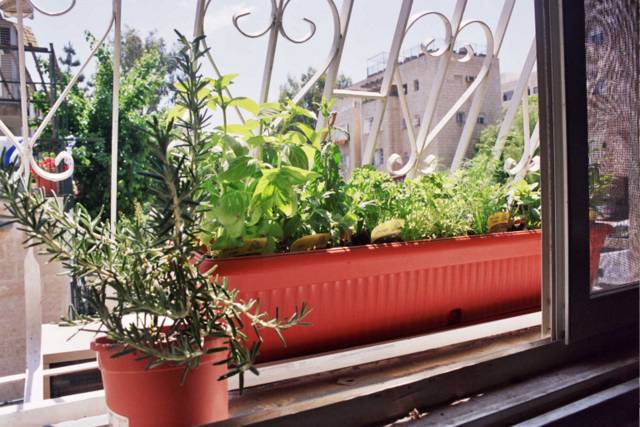
This is my herb "garden." In the foreground: fresh rosemary for roasting with vegetables or baking with chicken. Mmmm. In the background, from left to right: basil for making pesto, mint for my tea, parsley, oregano, dill for my vegetable soups, cinnamon basil (basil with a touch of cinnamon scent- mmm!), and tarragon behind the window screen.

BTW, I asked my rabbi, and it turns out I have to take terumot and maasrot from the herbs when I use them, even though they are not technically planted in the ground itself. (If you don't know what that is, uh . . . try Googling it. Or maybe a nice commenter can explain it in English better than I could . . . ) How cool is that? I haven't done that since I made aliyah, since all the stores where I buy my fruits and vegetables have already taken care of it.

Anyone have ideas for what I can do with fresh oregano, basil that smells a little like cinnamon, or fresh tarragon? I have no idea . . . Posted by Picasa

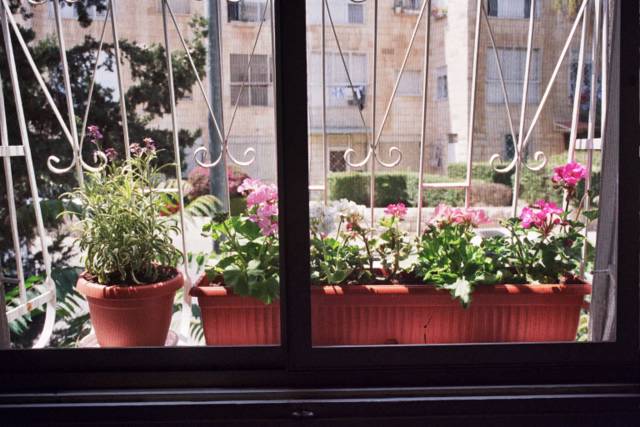
Pink, violet, and white geraniums facing the street. Posted by Picasa
Congrats to Susan

The Press Club of Western Pennsylvania has granted two Golden Quill Awards to Susan, who happens to be my former roommate and a dear friend, in addition to being a kick-*ss reporter. (Bet you never thought you'd see that on my blog, especially not in the same sentence as "Susan," didja? I hope Susan will forgive me . . . )

One award was in Investigative/Enterprise reporting, and the other is for Spot News.

Good going, Susan! Kain yirbu!

Tuesday, May 23, 2006

English for the Hebrews

I acquired a new client today.

I'm so glad that Israel requires companies to provide generous terms for maternity leave . . . this is my second job covering for a woman who just had a baby . . .

I'll be providing almost all the written content for several children's magazines, at different levels of complexity. The publications are geared to Israeli children and teenagers who are learning English as a foreign language.

So, over the next few months, I'll be looking for amazing trivia facts; fun stories about food, animals, sports, and celebrities; interesting cultural notes about Israel and other countries; short works of fiction (that we can publish for free and without worrying about copyright issues); games and activities; and odd news from around the world. Should be fun.

This is a part-time job, so I'll still be working on other projects. But it feels good to have a large assignment that I can really sink my teeth into.

Monday, May 22, 2006

Taking Responsibility for Oneself

The following letter from the dean of Pardes was included in the school's latest monthly newsletter, and I found it quite moving on several levels. Thought I'd share it with you . . .

Dear Friends,


::snip::


I would like to share a “Pardes moment” with you. Last week at Pardes, we celebrated a “Pidyon ha-Ben.” This ceremony involves a Cohen, and an exchange of coins, by which a first-born son is redeemed on the 31st day of his life, assuming both his parents were not of Cohen or Levi descent, that there were no previous miscarriages, etc.

It’s actually pretty rare -- I’ve only been to a couple in my life. Some say that it is a redemption marking the fact that eldest sons need not serve in the Temple, which became the task of Cohanim and Levi’im (hence, they do not require this ceremony); others see it as reminding us that our eldest sons are not to be offered up as human sacrifices, as Canaanite idolators were wont to do; some say it hearkens back to the saving of the Jewish first-born sons during the last plague in Egypt.

But this “Pidyon ha-Ben” was not performed, as you might have thought, to redeem the first-born male child of an Israelite teacher at Pardes. As they were learning in Talmud class, Masechet Kiddushin 29a, which describes the obligations of a father to his son (and also vice-versa), one of the Pardes classes began discussing this mitzvah of “Pidyon ha-Ben.” A student realized that he fit the description, and when checking with his mother, learned that the ceremony had never been performed.

Last week, a good number of Pardes students attended a Pidyon ha-Ben ceremony for this student, for many the first time they attended a Pidyon ha-Ben ritual. Unusual as the ceremony is, it is even rarer to find it performed for a 27-year old! As in the case of ritual circumcision, the Halacha teaches us that if the parents do not fulfill the mitzvah on the child, it devolves to the child (when reaching adulthood) to assume responsibility for the performance of the mitzvah. (In fact, earlier this year, two other Pardes students realized that their parents had them circumcised in a hospital immediately after birth, and not as part of a ritual Jewish ceremony with a mohel, bracha (blessing), etc. They initiated a “hatafat dam brit” for themselves -- a quick, painless procedure performed by a mohel. The students showed up to learn minutes later, and didn’t look the worse for it!)


Faculty member Rabbi David Levin-Kruss explained to those present that there is an important lesson to learn from this Halacha – while our parents might not provide us with everything we would want them to, we cannot simply complain about it; we must take responsibility for ourselves at a certain point in life, and give ourselves those things we need which we never received from our parents.


Both he and I saw another parallel case in the room – the mitzvah of Talmud Torah, learning Torah. In the same Talmudic sugya (passage), it is stated that a father must provide a Torah education to his sons, something that today has thankfully been extended to daughters. Sitting (and standing) in the room at that moment were Pardes students, many of whom felt that the Jewish education they received as children was not complete. While there was much their parents did provide them, learning the classical texts of our tradition in the original was not one of those things.


And here they all were, nearing the end of an academic year of Torah learning at Pardes, not complaining about what they were not given; instead, they had taken the initiative (sometimes with the support of their parents, sometimes without) to stop their life and come to Jerusalem to study those texts, and their Jewish heritage, for a year.


At least for the faculty present, I know it was a moving moment, seeing the dozens of students in the room. They are all graduates of fine universities, and some are in the early stages of very successful careers; and yet many of them chose the hard road of “infantilizing” themselves, putting themselves in the position of semi-literates, in order to engage in serious study of Jewish texts. It is no wonder, I told them, that most Jews their age do not do this, as it is so hard.


Our students are truly a remarkable group of young men and women, and we have much to be thankful for.


Sincerely,

David I. Bernstein, Ph.D.

Dean

Sunday, May 21, 2006

If ever there was a plug for the mitzvah of returning lost objects . . .

This is it.

Poor Todd.

I laughed out loud at the end of this story. Read the whole thing.
Appreciation Wednesday on Sunday: More Flowers

In my neighborhood are several traffic circles (also known as roundabouts, or rotaries, depending on where you are from), and every one of them is covered with gorgeous, blooming flowers. And in each one, someone clearly put thought into making a design with the different types and colors of plants.

It's really nice to live in a neighborhood beautified in such a way. So, I appreciate the gardeners who planted and tend to the traffic circle mini-landscapes, and the municipal decision-makers who decided to allocate funds for such a thing. There's nothing like passing by a traffic circle exploding in red and yellow tulips to brighten one's day.

Thursday, May 18, 2006

New Roommates

I'm so excited! After three years of dreaming about it, I went tonight with Yael to a beautiful plant nursery in Abu Gosh, and she helped me pick out window boxes and plants to go into them (and the necessary supplies)! I don't know ANYTHING about gardening, so Yael's expertise was badly needed. Without her, I would have gotten overwhelmed by all my choices, and would have been afraid to touch a flower for fear I'd kill it, the way some people are afraid of touching a computer. Yael is in charge of the garden of her building, and she's even taken a course in gardening, so when she talks about plants, I listen.

Anyway, we came home and made a big mess transferring dirt, fertilizer, and young plants into long window boxes and setting them in place.

Facing the street I have geraniums in various shades of pink, purple, and white, plus one other (taller) plant with little purple flowers.

On the windowsill on the other side of my apartment I now have an herb garden! We're talking fresh rosemary, mint, dill, tarragon, oregano, parsley, and basil! Smells AMAZING.

Pictures to come!

Wednesday, May 17, 2006

Tired

Last night I made the mistake of reading some of the comments posted by members of the public to an article in one of Israel's online newspapers. There sure are a lot of mean-spirited, ignorant, hysterical, and/or simply dumb people out there.

Today I called an office in America to arrange to speak with someone I need to ask about something, and when the secretary heard I'm in Jerusalem, she started asking me many, many questions about life here, and the "situation." I answered as carefully and honestly as I could, trying to be fair to Israel without being completely one-sided.

It turned out that she subscribes to the "moral equivalency" population of people who believe that since more Palestinians have died, it must mean Israel is the bad guy. Some Palestinians have had their olive groves destroyed, so Israel must be making a land grab, settlers are taking land without caring about other people's livelihoods, etc.

I did the best I could to educate her about the subtleties of the situation. Of course I couldn't say that Israel is always "right" -- I don't think it always is myself, and even if I did think it, it wouldn't be diplomatic to say in this case -- but she clearly was in desperate need of some shades-of-gray.

When I hung up, I realized that I'd been holding my breath a lot. I felt very tired.

I'm so tired of caring what other people think, of knowing that just about everyone in the world hates me and everything I stand for at worst and finds my country mildly irritating at best. I'm tired of worrying about a nuclear bomb falling on my head, tired of being on the defensive, tired of thinking constantly about whether there is a solution, tired of feeling helpless when other people do something dumb, tired of being held to a double standard, tired of holding myself to a double standard. I'm tired of caring so much. I guess I'm tired of caring so much about being a Jew.

I could disengage from the whole thing (pun not intended, I think), and simply decide not to get emotionally involved, and certainly not to write about the "situation" any more. I could, in theory, stop reading the news entirely.

But that last is tough, given that news is my job. And also, if I don't stay abreast of what's going on and form opinions and make them heard, then I can't complain about the decisions that other people make on my behalf. I only have the right to an opinion if I throw myself into the argument and become part of the process of making things better, if that is possible. If I don't make this whole thing my business then, well, it will be none of my business.

Besides, it's a little late for me to pretend I don't care. I made aliyah. The jig is up.

So I'll keep reading the news, and annoying blogs, and stupid comments on news sites; and I'll keep blogging my opinions sometimes and taking the heat from (sometimes obnoxious) commenters; and I'll keep talking to secretaries who are missing important information. I'll keep worrying and thinking and wallowing in confusion until my head threatens to split open.

But I'm so tired.